
Terminology Management and Terminology Services
GF South Africa · DHU Lunch & Learn series
Friday, 7 August 2026 · DHU Lunch & Learn
Where We Left Off
Client Registry
Facility Registry
Health Worker Reg.
Terminology Service
Today's throughline: what happens inside the Terminology Service box — both what it technically does, and the governance behind it.
Speaker notes ▾
Connected — But Not Understood
A patient is diagnosed at a clinic. The record is sent, successfully, to a national data platform.
✓ Transaction succeeded. No error, no rejection.
Source: a real national terminology programme's own account of this exact failure mode, 2026. Codes shown are illustrative — real, valid ICD-10 codes chosen to fit the pattern described, not the literal codes from the original incident.
Did Anything Break?
Nothing errors out. The systems are connected, and the message arrives — but the meaning didn't survive the trip.
That's the gap this whole session is about closing.
Speaker notes ▾
Terminology vs. Terminology Service
Terminology
The content — a set of codes and meanings. LOINC, ICD-10, or a local code system are all terminologies.
Terminology Service
The software that makes that content queryable and keeps it in sync with the systems using it.
This distinction is the spine of the whole session — everything else today is either about the content, or about the service that manages it.
What Does a Terminology Service Actually Do?
Other systems ask it questions, in real time:
A terminology service isn't a static list — it's a live service other systems query constantly.
Speaker notes ▾
Governing Codes Over Time
Someone has to own an ongoing set of decisions:
South Africa Already Has One
This isn't a hypothetical "someone should build this." South Africa's own health information regulations already name a single authoritative mapping service.
This is the National Terminological Mapping Service — South Africa's own real, named version of "governing codes over time." We'll come back to this shortly.
Speaker notes ▾
Four Terminologies, Each With a Best Lane
That overlap is exactly why a country needs more than one — and why mapping between them is what makes a single patient's data comparable across facilities, provinces, and national reports.
Speaker notes ▾
Localizing Doesn't Always Mean Shrinking It
Taiwan's national disease-surveillance programme didn't load all 100,000+ LOINC codes — it mapped local lab results to just the codes needed for notifiable-disease reporting, then rolled that subset into its national electronic lab reporting system.
The US went the opposite direction with ICD-10: ICD-10-CM keeps every WHO category but adds far more granular, US-specific codes on top — nearly five times as many.
Either way, a country selects and governs its own version of a global standard — sometimes that means narrowing it to a relevant subset, sometimes it means extending it with local detail the global classification didn't anticipate.
Speaker notes ▾
Meet Nomsa
Nomsa, 34, is on ART at her district's primary clinic. She's later admitted to the district hospital with a new TB diagnosis.
| Step | Standard terminology | Illustrative code | Local/facility code in parallel use |
|---|---|---|---|
| Clinic — HIV diagnosis | ICD-10 → ICD-11 (SA's designated target) | B20 (ICD-10) | Paper register: free-text "HIV+" |
| Clinic — clinical concept | SNOMED CT / GPS | 86406008 — HIV infection | — |
| Clinic — CD4/viral load result | LOINC | 20447-9 — HIV 1 RNA [#/volume] (viral load) in Serum or Plasma by NAA with probe detection | EMR field "VL result," not mapped to LOINC |
| Clinic — ART regimen | ATC/DDD | J05AR27 — lamivudine, tenofovir disoproxil and dolutegravir (TLD) | Shorthand "Regimen 1a" |
| Hospital — new TB diagnosis | ICD-10 → ICD-11 | A15.0 (ICD-10) | Hospital's own GeneXpert lab-order code |
Fabricated patient and facilities — but the standard-terminology codes above are real, publicly documented codes (see speaker notes for sources), not placeholders. Only the "local/facility" column is invented. The ICD-10→ICD-11 transition shown here is real and current — South Africa's own National Terminological Mapping Service is what handles exactly this translation.
Speaker notes ▾
What Happens When Nomsa Is Referred?
Without governed mapping between local shorthand and global codes, her data can't reliably follow her — and it can't be aggregated into a provincial or national report either.
Her ICD-10-to-11 transition adds a second, real mapping dimension on top of the local-shorthand one — "between systems" and "between versions" are both live for Nomsa's record right now, and both are exactly what South Africa's own National Terminological Mapping Service exists to handle.
Four Building Blocks of a Well-Governed System
All four reinforce each other. Technology without Governance has no rules to enforce; Content without Community has no source of shared standards to draw from. A well-governed national terminology system needs all four working together — not any one of them alone.
The Terminology Maturity Model
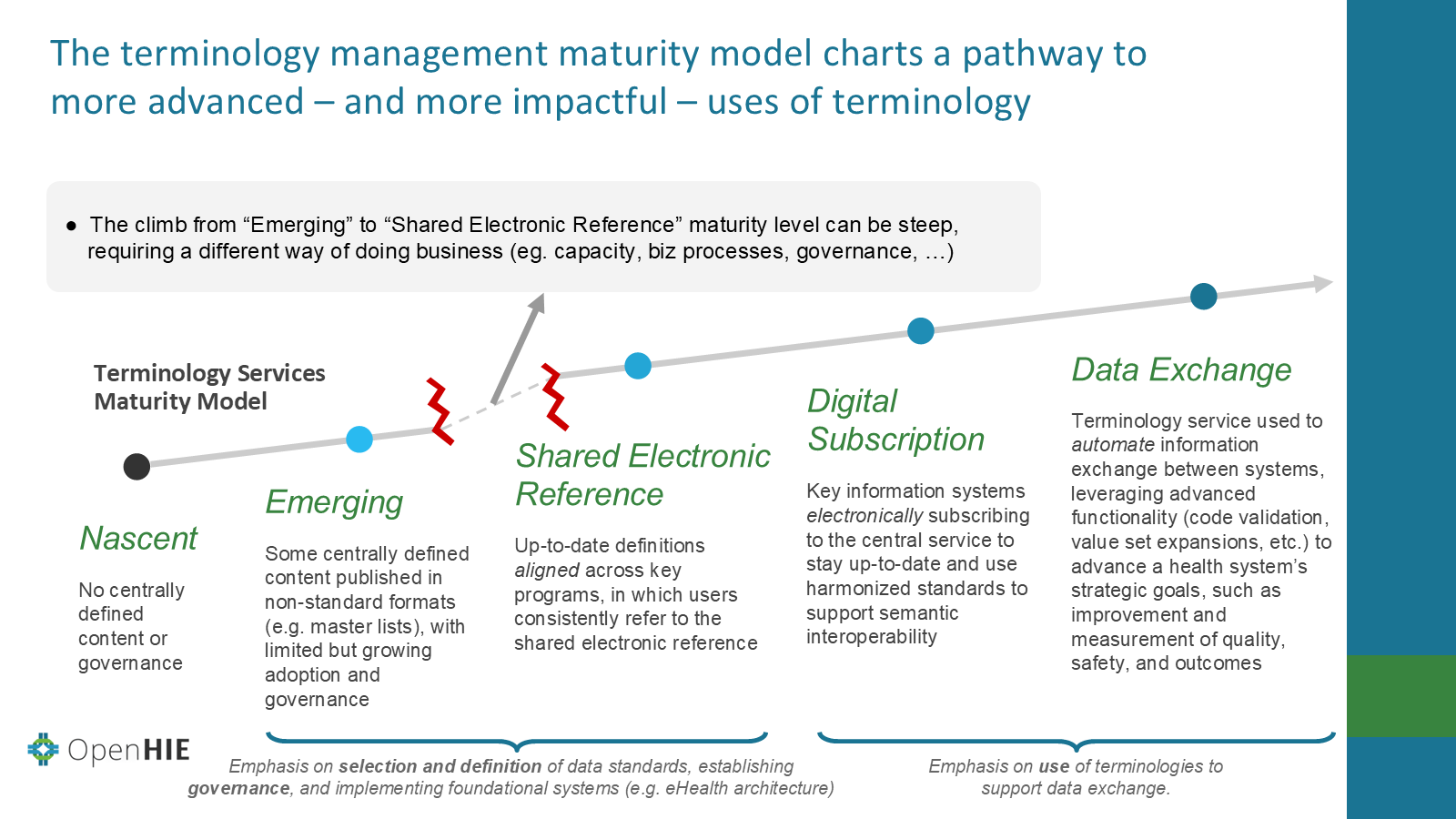
Most LMICs — and most provinces/programmes in this room — sit somewhere in the first two or three rungs. That's normal.
Is a Spreadsheet a Shared Electronic Reference?
A "master list" spreadsheet or PDF
Emerging — even a well-maintained one, if programmes keep their own separate copies and use it siloed, ad hoc.
Shared Electronic Reference
Programmes consistently refer back to one place as definitions change — that's the difference, not the file format.
If your programme already keeps a spreadsheet of standard codes — that's Emerging, and Emerging isn't nothing. It's a real, named step. The climb is in how consistently it gets used, not in making the file nicer.
Speaker notes ▾
Moving Up a Rung: What Actually Changes
The climb isn't about better technology alone — each rung asks for a different move in Content, Governance, and Use.
| Moving from → to | Content | Governance | Use |
|---|---|---|---|
| Emerging → Shared Electronic Reference | Pick 1–2 priority domains (e.g. a drug list or disease-code set) and publish one shared definition, not scattered spreadsheets | Stand up a governance process — even lightweight — with named stakeholders at the table | Name one system as the terminology reference and require programmes to point back to it |
| Shared Electronic Reference → Digital Subscription | Extend shared definitions from priority domains to most of the country's major content areas | Make the governance process consistent and routine, not ad hoc — even if scope stays narrow | Move from manual look-up to electronic subscription, so systems auto-update instead of copy-pasting |
| Digital Subscription → Data Exchange | Coordinate standards development and publication across every major programme and domain, not just most | Make stakeholder engagement the default for every decision, not the exception | Wire the reference into live transactions — validation, translation, value-set expansion — and into system-wide monitoring |
Each step is a smaller, concrete move — not a leap. Most programmes climb one cell at a time, not one row at a time.
Speaker notes ▾
Kenya: Harmonizing What Already Existed
Kenya didn't start from zero, and didn't discard what already existed — it reconciled two pre-existing local dictionaries into a shared one, then filled gaps with global standards. That's now a public Shared Electronic Reference: knhts.health.go.ke.
Speaker notes ▾
Localizing a Terminology: Two Directions
↓ Subsetting
Take global standards (SNOMED, ICD, LOINC) and select the slice that's locally relevant.
↑ Harmonizing
Take what's already locally in use — like Nomsa's clinic and hospital shorthand — and reconcile it up into something nationally shared and governed.
Neither direction alone is sufficient. The top-down half is already under way for South Africa — the 7 designated systems and National Terminological Mapping Service are exactly this. What's still unconfirmed is the bottom-up half: the actual inventory of existing facility/programme dictionaries — like Nomsa's shorthand codes — that will need reconciling into it.
Where Are You on the Ladder?
Kenya & Brazil: What Success Looks Like
Two countries that have already climbed this ladder — with named governance, published content, and live technology serving real transactions, not just a plan.
| Building block | Kenya (KNHTS) | Brazil (RNDS) |
|---|---|---|
| Technology |
|
|
| Content |
|
|
| Governance |
|
|
| Community & use |
|
|
Every checkmark here started as an open question — the same ones on the table for South Africa today.
Speaker notes ▾
What's Still Open — and How to Get Involved
Speaker notes ▾
Knowledge Check
Priority questions:
- What terminologies — global and local — are already being used in your settings?
- Where does your own domain sit on the maturity ladder today, and what's the one governance decision that would move it up a rung?
Thank You
Today: what a terminology service does, how SNOMED CT/ICD-11/LOINC relate, how localization works in both directions, South Africa's own designated systems and governance structure, and the four building blocks of a well-governed national terminology system.
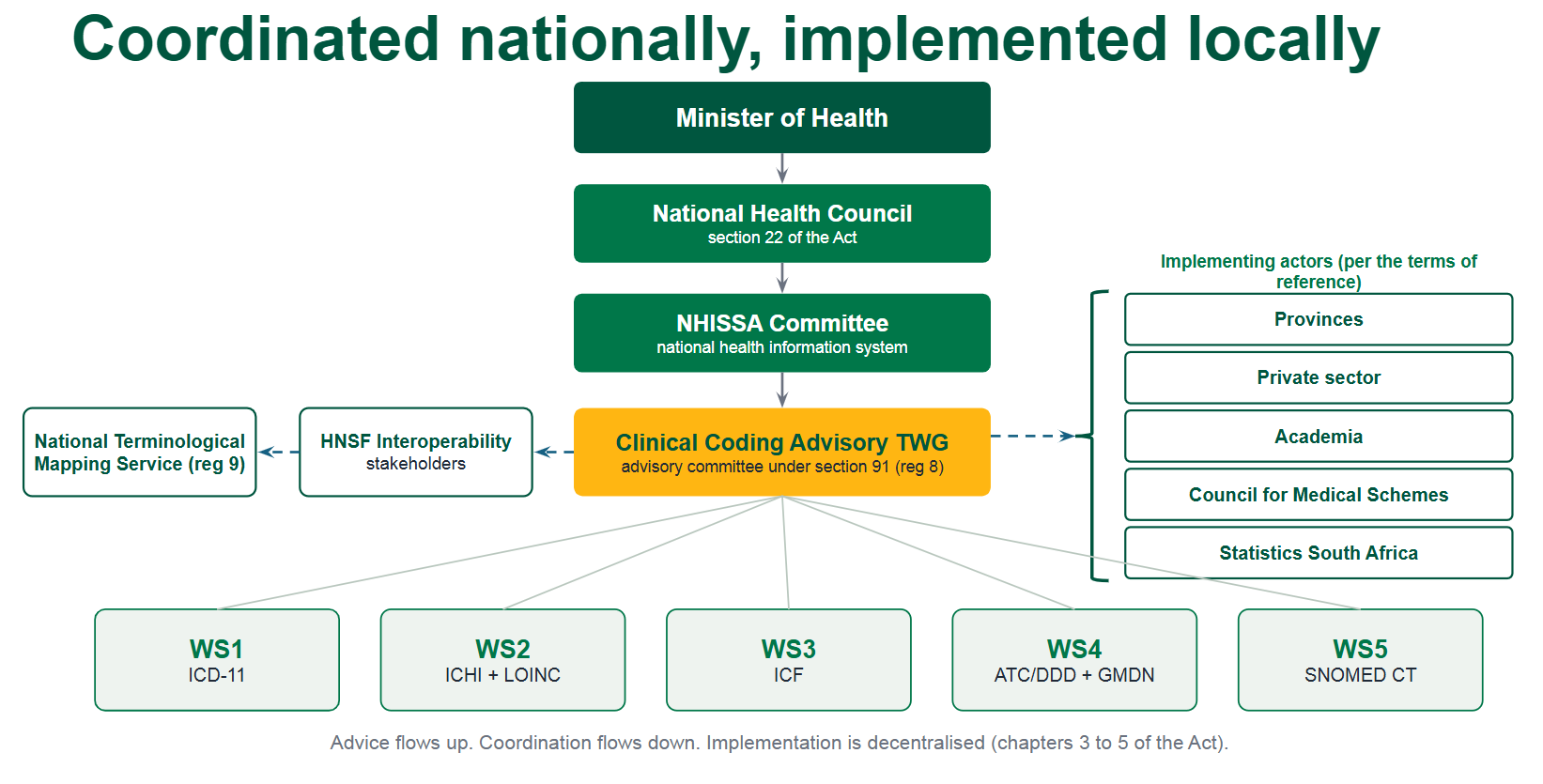
South Africa's Structure, in Detail
Backup slide — same governance-chain and stat detail as before, kept here for Q&A rather than the main flow.
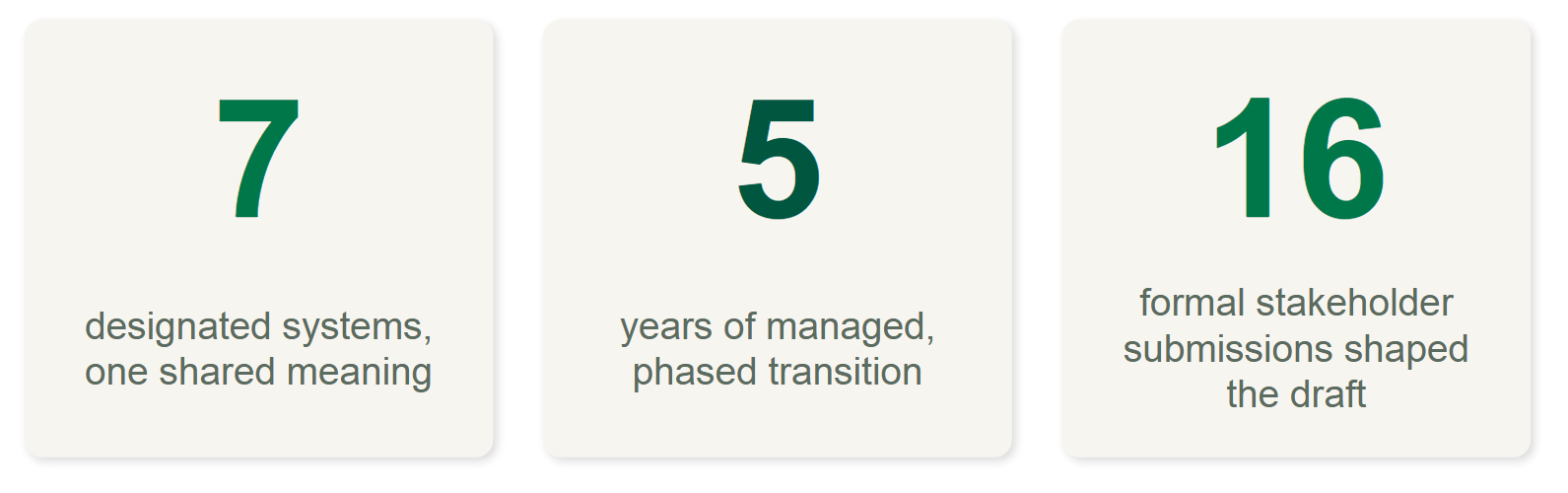
Governance chain: